The HFEA's newsletter on fertility treatment data |
| |
|
Welcome to the first ‘Data research update’ newsletter from HFEA! |
This quarterly newsletter aims to provide information about the UK national register of fertility treatments held by the HFEA, including details on our upcoming reports and our award-winning dashboard, as well as further information on how to access data from our national UK fertility register for research purposes via the Register Research Panel (RRP). We will include information on updates to our publicly available anonymised register datasets, and information on upcoming events such as webinars. |
|
|
New HFEA report - Fertility treatment 2022: preliminary trends and figures report |
|
|
New data from the recently published Fertility treatment 2022: preliminary trends and figures report shows that fertility patients are starting treatment older, although the success rates of treatment generally decline with age.
The average age of patients starting IVF was over 35 years old for the first time. As the success of fertility treatment declines with age, this could impact on patients’ chances of success. This report highlights both the necessity of early contact with a GP and an early referral to fertility services when needed.
This report uses data from the HFEA Register, and covers a broad range of topics, including successes made across the sector in reducing the multiple birth rate to a record low of 4%, as of 2022. However, the report also found the overall number of NHS-funded IVF cycles decreased once again across the UK with an average of 27% NHS-funded in 2022, dropping from 40% in 2012.
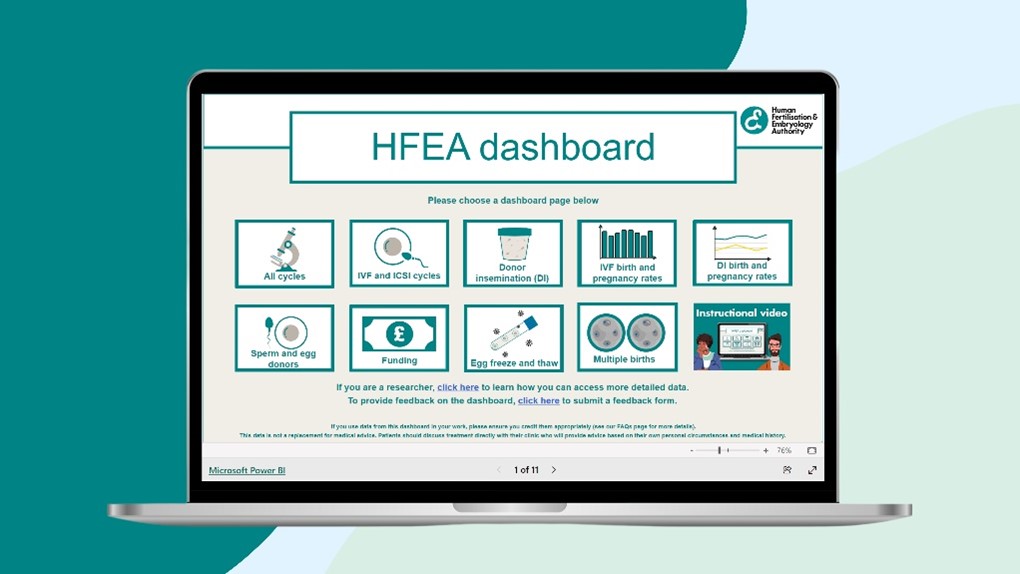
An update to the HFEA dashboard was released at the same time, and provides interactive data from 1991-2022 on a range of topics, with a recently added page on donor insemination (DI) pregnancy and birth rates.
The next planned publication is the second report on 'Family formations in fertility treatment 2022', following the first report published in 2020, to be published in winter 2024/25. |
|
|
HFEA dashboard wins award for Statistical Excellence from the Royal Statistics Society (RSS), Office for statistics Regulation and Civil Service World |
|
|
Have you accessed the HFEA dashboard? In January 2024, the HFEA launched what is thought to be the first fertility dashboard of its kind in the world. We are delighted that our dashboard was announced as the 2024 winner of the Award for Statistical Excellence in Trustworthiness, Quality and Value at their award ceremony on 10 July 2024.
The award was made by the Office for Statistics Regulation, in partnership with the Royal Statistical Society (RSS) and Civil Service World, and celebrates good practice in voluntary application of the Code of Practice for Statistics, recognising outstanding innovations and developments that improve user experiences.
Peter Thompson, Chief Executive of the HFEA, said: “We’re delighted that the HFEA dashboard has won this year’s Trustworthiness, Quality & Value award."
“Our dashboard, which we believe to be the first of its kind in the world, is designed to provide impartial information in an easy-to-use format to help inform the many difficult decisions around fertility treatment. This award is a real tribute to the quality of work of our expert team at the HFEA and a recognition of the huge interest in UK fertility data."
“The HFEA will continue to build on the work recognised by this award and enable the public, clinicians and researchers to access the data we collect. Thank you to the Office for Statistics Regulation and the Royal Statistical Society for the award.”
At the upcoming RSS annual conference, the HFEA team will give a talk at the Celebrating Statistical Excellence session: Insights from award-winning teams in official and non-official statistics on 3 September 2024. There will be two further presentations on the HFEA dashboard: an oral presentation Developing the world’s first fertility treatment dashboard on 3 September, and a poster presentation Making the ‘world’s first’ fertility dashboard accessible on 4 September. Please do come and join us if you are attending the conference.
|
|
|
Launch of the Register Research Panel (RRP) project webpages |
|
|
The Register Research Panel (RRP) is a committee of the HFEA that decides whether to grant applications from researchers to access personal data from the HFEA Register for research purposes. You can now find information on the ongoing projects approved by Register Research Panel on our data research webpage; here you can see how our Register data is being used in research projects.
We have also included updated versions of our application form on our data research webpage. If you are interested in using personal data from the HFEA Register for your research, please contact us via the RRP enquiry form. You can also find our publicly available anonymised data register on our Data Research webpage, this covers treatment cycles undertaken between 1991 and 2018 and RRP approval is not required for access.
RRP meetings are held every two months, and deadline to receive applications is four weeks prior to each meeting and the RRP functions on a first come first served basis (at the time of final submission). |
40th annual meeting of the European Society of Human Reproduction and Embryology (ESHRE) |
The 40th annual meeting of the European Society of Human Reproduction and Embryology (ESHRE) was held in Amsterdam from 8 -10 July 2024.
A poster on Ethnic diversity in fertility treatment in UK was presented during this conference. The full ethnic diversity report was published in December 2023 along with a call to action from the HFEA, Royal College of Obstetricians & Gynaecologists, Royal College of General Practitioners, British Fertility Society and Fertility Network UK, to urge for action to be taken to reduce the health disparities.
|
|
|
Publications using personal data from the HFEA register data |
The list includes publications since 2022. We rely on researchers to let us know when they have published research using our datasets.
If you have a publication to contribute to the bibliography below, please contact us at register.research@hfea.gov.uk. The list of publications prior to 2022 can be found on our website.
Publications using data obtained through the Register Research Panel (RRP) |
|
|
-
Hua, X., Rivero-Arias, O., Quigley, M. A., Kurinczuk, J. J., & Carson, C. (2023). Long-term healthcare utilization and costs of babies born after assisted reproductive technologies (ART): a record linkage study with 10-years’ follow-up in England. Human Reproduction, 38(12), 2507–2515.
-
Ratna, M. B., Bhattacharya, S., & McLernon, D. J. (2023). External validation of models for predicting cumulative live birth over multiple complete cycles of IVF treatment. Human Reproduction, 38(10), 1998–2010.
-
Raja, E.A., Bhattacharya, S., Maheshwari, A., & McLernon, D. J. (2023). A comparison of perinatal outcomes following fresh blastocyst or cleavage stage embryo transfer in singletons and twins and between singleton siblings. Human Reproduction Open, 2023(2).
-
Kondowe, F. J. M., Clayton, P., Gittins, M., D’Souza, S. W., Brison, D. R., & Roberts, S. A. (2023). Growth of twins conceived using assisted reproductive treatments up to 5 years old: a national growth cohort. Human Reproduction.
-
McLernon, D. J., Raja, E. A., Toner, J. P., Baker, V. L., Doody, K. J., Seifer, D. B., Sparks, A. E., Wantman, E., Lin, P. C., Bhattacharya, S., & van Voorhis, B. J. (2022). Predicting personalized cumulative live birth following in vitro fertilization. Fertility and Sterility, 117(2).
-
Raja, E. A., Bhattacharya, S., Maheshwari, A., & McLernon, D. J. (2022). Comparison of perinatal outcomes after frozen or fresh embryo transfer: separate analyses of singleton, twin, and sibling live births from a linked national in vitro fertilization registry. Fertility and Sterility, 118(2), 323–334.
-
Ratna, M. B., Bhattacharya, S., van Geloven, N., & McLernon, D. J. (2022). Predicting cumulative live birth for couples beginning their second complete cycle of in vitro fertilization treatment. Human Reproduction, 37(9), 2075–2086.
-
Sharpe, A., Mascarenhas, M., & Balen, A. (2022). Ethnic variation in the live birth rate and perinatal outcomes following frozen embryo transfer: an analysis of the HFEA database from 2000 to 2016. Human Fertility, 25(3), 583–592.
-
Sutcliffe, A. G., Purkayastha, M., Brison, D. R., Nelson, S. M., Roberts, S. A., & Lawlor, D. A. (2022). General health in a cohort of children conceived after assisted reproductive technology in the United Kingdom: a population-based record-linkage study. American Journal of Obstetrics and Gynecology, 228(1).
|
-
Allen, C., McLernon, D., Bhattacharya, S., & Maheshwari, A. (2023). Early pregnancy outcomes of IVF cycles using donor versus partner sperm: analysis of 1 376 454 cycles recorded by the Human Fertilisation and Embryology Authority (1991–2016). Human Reproduction.
-
Bambaranda, B. G. I. K., Bomiriya, R., Mehlawat, P., & Choudhary, M. (2022). Association of extended culture to blastocyst and pre-malignant gestational trophoblastic disease risk following IVF/ICSI-assisted reproduction cycles: an analysis of large UK national database. Journal of Assisted Reproduction and Genetics, 39(10).
- Shen, L., Zhang, Y., Chen, W., & Yin, X. (2022). The Application of Artificial Intelligence in Predicting Embryo Transfer Outcome of Recurrent Implantation Failure. Frontiers in Physiology, 13.
-
Zhang, Y., Shen, L., Yin, X., & Chen, W. (2022). Live-Birth Prediction of Natural-Cycle In Vitro Fertilization Using 57,558 Linked Cycle Records: A Machine Learning Perspective. Frontiers in Endocrinology, 13.
-
Lewin, J., Lukaszewski, T., Sangster, P., Williamson, E., McEleny, K., al Wattar, B. H., & Yasmin, E. (2022). Reproductive outcomes following surgical sperm retrieval in couples with male factor subfertility: A 10-year retrospective national cohort. Fertility and Sterility.
-
Allen, C. P., McLernon, D. J., Bhattahcharya, S., & Maheshwari, A. (2022). Perinatal outcomes of 221,709 singleton and twin pregnancies after the use of donor versus partner sperm. Fertility and Sterility, 118(5), 948–958.
-
Henderson, I., Lacey, L., Akhtar, M. A., & Quenby, S. (2022). Ethnic group and reason for ART failure: analysis of HFEA registry data from 2017-2018. Fertility and Sterility.
-
Roberts, S. A., Wilkinson, J., Vail, A., & Brison, D. R. (2022). Does PGT-A improve assisted reproduction treatment success rates: what can the UK Register data tell us? Journal of Assisted Reproduction and Genetics.
|
|
|
Editorial statement
Data research update is an official electronic newsletter of the Human Fertilisation and Embryology Authority, is produced by the HFEA and provides a roundup of news and information on the Register data and Register Research Panel activity. No part of this publication may be reproduced without prior permission. You can view our privacy policy on our website.
Click here to unsubscribe. 2 Redman Place
London
E20 1JQ |
|
|
|